Ultimate Guide: How to Design a Bathroom Layout for a Dream Bathroom
- Planning a New Bathroom: Start With Your Daily Routine Before Drawing Anything
- Measure Accurately And Transform This Into a Scale Floor Plan
- What Dictates The Layout And Budget: Piping, Drainage And Soil Pipe
- Budget In The UK: Define The Type of Renovation Before Falling In Love With Finishes
- Bathroom Design for Flow, Privacy, and Comfort
- Choose Pieces That Match Your Routine And The Actual Space
- Storage, Bathroom Walls and Bathroom Floor
- Comfort And Standards In The UK: Ventilation, Electrical And Water Efficiency
- How Mermaid Bathrooms Can Help
- Why Choose Mermaid?
- Summary
- FAQ
When someone starts planning a new bathroom in the UK, the first question is almost always: how big is my bathroom?
Size matters, but it doesn’t decide whether the space feels comfortable day to day. In practice, how to design a bathroom layout comes down to lifestyle: your morning routine, children, conflicting schedules, storage needs, mobility, time (or lack of it) for cleaning, and even how you like to unwind at the end of the day. That’s why many designs look fine on paper but feel frustrating in real life.
Most bathroom layout ideas are designed for square metres rather than people. And it’s worth remembering that UK bathrooms are often compact: many guides use a standard room of around 1.5–1.8 m × 2.4 m, and treat anything under about 4 m² as a small bathroom—common in smaller properties. If you’re reconfiguring the house as part of a wider renovation, the bathroom’s position can also affect what’s practical to move.
The good news is you can still create a dream bathroom, as long as you design for flow and the right choices, rather than trying to cram in everything you’ve saved on Pinterest.
In our ultimate guide to bathroom design, you’ll learn how to prioritise routine over size, measure and draw a floor plan to scale, understand how the soil pipe can affect layout and cost, and get the bathroom floor, bathroom walls, ventilation, and comfort right—without complicating the project.
Planning a New Bathroom: Start With Your Daily Routine Before Drawing Anything
Before thinking about showers, bathtubs, and tiles, think about behaviour. What do you actually do in that bathroom?
If it’s a family bathroom, peak usage is usually in the morning and at the end of the day. If it’s an en-suite, priorities are often quick functionality on weekdays and comfort at weekends. If there are small children, a bathtub may be essential. And if accessibility matters, the bathroom layout needs to allow movement and access without awkward manoeuvres—prioritise easy access to the shower and basin.
A simple rule that avoids expensive mistakes is to separate what’s essential from what’s a nice-to-have. Core bathroom products (toilet, sink, shower or bath) should support day-to-day use and be easy to clean. Extras—like storage upgrades or heated towel rails—can add comfort or luxury, but they’re worth considering only if they don’t disrupt flow, reduce usable space, or add maintenance.
Measure Accurately And Transform This Into a Scale Floor Plan
The step that saves the project the most is the one many people skip: measure carefully and draw the bathroom to the same scale before buying anything.
Aim for a simple floor plan (viewed from above) showing doors, windows, niches, cut-outs and sloping ceilings. Even a quick sketch on graph paper helps you test your bathroom layout and spot clashes that only show up on paper—door swings, cabinet drawers, shower enclosure openings, and the kind of dead space that becomes a daily trip hazard. Practical tip: mark door swings and drawer pull-outs before you commit to any fixture sizes.
In a small bathroom in the UK, we at Mermaid recommend leaving at least 60 cm of clear space in front of the sink, toilet and shower entrance, and checking that the main door and shower door don’t hit fittings when opened. These small tweaks can create a completely different sense of enough room, without knocking anything down.
What Dictates The Layout And Budget: Piping, Drainage And Soil Pipe
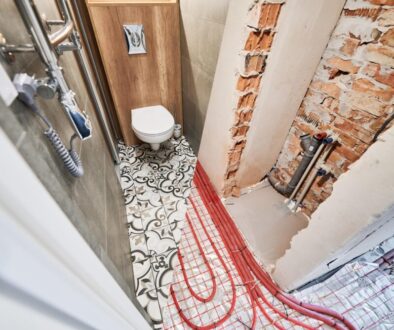
A bathroom layout is rarely a blank canvas. The position of the toilet is usually constrained by drainage and the existing soil pipe, and moving it too far often increases the cost—demolition, longer runs, new pipework and more labour time.
A good rule of thumb is to keep as much as you can where it is, as long as usability doesn’t suffer. And if you do change the bathroom layout, make it a real upgrade: better circulation, cleaner flow, more storage, or a more comfortable bathing zone.
One useful detail in many bathroom layout ideas is that when the soil pipe sits on the back wall, you may have a bit more flexibility (depending on the existing routes). In some ground-floor bathrooms, if you have external access and the conditions are right, that can also make a wet room more realistic—provided the falls, drainage and waterproofing can be done properly, and it genuinely suits how the room is used.
Budget In The UK: Define The Type of Renovation Before Falling In Love With Finishes
In the UK, costs vary because the price isn’t just what you buy—it’s how much you change what’s already there.
As a current reference, many UK cost guides put the average bathroom renovation at around £4,500. Avoiding major bathroom layout changes usually keeps costs down, because moving pipework adds time and labour. For a full renovation, a typical range is £4,500–£7,000, depending on size, materials and the extent of the work. Also factor in the cost of removing and disposing of the old bathroom, as this can add noticeably to the total.
The most helpful decision is to classify your project into one of three levels:
- Simple update: like-for-like replacement with no major layout changes (usually the most budget-friendly).
- Light remodelling: targeted improvements and small adjustments.
- More extensive renovation: a real change to layout and/or services.
Whether you’re renovating on a DIY basis or hiring professionals for bathroom installations, it’s worth getting multiple quotes so your budget and timeline reflect the market.
Once you know which level you’re working at, it becomes much easier to build a bathroom design that matches your budget and schedule—without starting small and ending up with an expensive surprise halfway through.
Bathroom Design for Flow, Privacy, and Comfort
A good bathroom is one you can walk into and move around without thinking. That’s flow: clear paths between fixtures, no detours, and no cramped pinch points.
As a general guide, aim for 700–760 mm of clear space in front of each fixture where possible. In tighter rooms, 60 cm can work as a practical minimum in some spots, but the closer you get to key areas, the more the room starts to feel cramped. If you’re planning for a truly wheelchair-friendly bathroom (for example, Category 3 requirements), allowing around 1500 mm for a turning circle helps ensure comfortable manoeuvring. In a compact bathroom, even small bathroom layout choices can create more space—for example, sliding doors can remove wasted swing area and free up floor space, helping you keep enough room where it matters.
Two decisions that usually improve everyday use:
- Toilet privacy: whenever possible, avoid it being the first thing visible when opening the door.
- Wet and dry zones: separating the bathing area from the countertop/storage area reduces splashing, improves maintenance, and keeps the room feeling calmer.
Bathroom Layout Ideas: Visualising Your Bathroom
Once you’ve drawn your scaled floor plan, take a moment to test a few different bathroom layout ideas. It’s one of the quickest ways to avoid costly mistakes and move closer to a dream bathroom that fits real life.
Start with a floor plan of your existing bathroom (or the area where the new bathroom will go). On graph paper, sketch the room to the same scale, marking doors, windows and any fixed points. This gives you a clear overview of your available space before you start moving pieces around. Then place the essentials—toilet, sink/basin, and bath or shower—and check clearances: door swings, shower enclosure openings, drawers, and whether there’s enough room and floor space to move comfortably.
As you refine the layout, match choices to routine: a walk-in shower for quick mornings, a double sink for busy households, or a wall hung toilet to free up floor area. In a small bathroom layout, sliding doors can reclaim dead space, and where conditions allow, a wet room can create a more open feel. Finally, sanity-check wall space for storage, the effect of natural light, and whether comfort upgrades like underfloor heating or heated towel rails suit your budget and maintenance. If you want to see options in 3D, online design tools—or an interior designer—can help you mock up the room before you commit.
Choose Pieces That Match Your Routine And The Actual Space
This is where lifestyle comes into play. Instead of choosing only what looks good in the showroom, think about the bathroom fitting in real life—plan and install fixtures that support your routine and suit the space.
If the goal is a quick daily shower, a walk-in shower is often the best use of the room, especially in narrow bathrooms. If the bathroom is shared by the family, a bathtub or a bath-shower combination is usually more practical. In smaller bathrooms, compact choices can make a noticeable difference to floor space—for example, a back-to-wall toilet keeps the footprint tidy without feeling compromised.
For small spaces, we at Mermaid recommend choosing between a walk-in shower, a bath over a shower, or a compact bathtub based on the length of the room and where the existing plumbing sits. Sometimes the right call is simply a 1500 mm bath when a 1700 mm model won’t fit.
Finally, if the bathroom door steals too much room, we continue to recommend sliding doors. They reduce dead space and improve circulation without changing the size of the bathroom. If you’re using a shower enclosure, clear glass can also help the bathroom feel more open.
Storage, Bathroom Walls and Bathroom Floor
If there is one clear difference between a beautiful bathroom and a good bathroom, it is storage. In smaller bathrooms, visual clutter quickly swallows the feeling of space.
The best results come from storage planned from the start and built into the design, not improvised later. Use wall space wherever you can: a mirrored cabinet, wall-mounted shelves (including space above the toilet), a vanity with drawers, recessed niches in the shower, and a tall cabinet for everyday items. Done well, this is one of the simplest ways to create more space without changing the room.
For finishes, what works is balancing style with maintenance. In 2026, more handcrafted-looking tiles (including zellige), richer colours, added texture and expressive shapes are becoming more popular. If you follow the latest bathroom trends, use bold texture or colour as an accent rather than across every wall. These finishes tend to work best on bathroom walls as an accent wall or focal zone, so you get impact without turning cleaning into a chore. For the bathroom floor (or bathroom flooring), prioritise durable, easy-clean materials and a surface that feels secure underfoot, especially in wet zones.
Natural Light and Lighting
Natural light also has a big impact on how open the room feels. Keep windows as unobstructed as possible and use clear glass where you can so light travels through the space. Large mirrors can amplify daylight, and the right ceiling lights and light colour help the bathroom feel brighter and more comfortable in the evenings.
Comfort And Standards In The UK: Ventilation, Electrical And Water Efficiency
The rules can vary by location, but the least glamorous details are the ones that make a bathroom work properly. Even the latest bathroom designs won’t perform well if ventilation, electrics and water choices are ignored.
Ventilation: Approved Document F sets a minimum intermittent extraction rate of 15 L/s for bathrooms. If the bathroom has no openable window, it also recommends controls that keep the extractor running for at least 15 minutes after the room is vacated.
Electrical: NICEIC notes that electricians registered with a recognised certification body are assessed against BS 7671 and should be able to advise on bathroom zones and installation requirements.
Water: Approved Document G sets a standard water consumption target of 125 litres/person/day in new homes (with an optional 110 in specific cases). The fittings approach is a useful shortcut for selecting efficient fixtures: WC 6/4 L (dual flush) or 4.5 L (single flush), shower 10 L/min, bath 185 L, basin taps 6 L/min (and sink taps 8 L/min). Even if you’re renovating rather than building from scratch, these benchmarks help align choices with real use and running costs.
How Mermaid Bathrooms Can Help
Small bathrooms work best when decisions are joined up: fixture depth, door openings, storage, natural light, ventilation, and what can (and can’t) be moved in the pipework.
Taken together, these choices reduce surprises during the build and lead to a bathroom that’s easier to use and maintain day to day.
Why Choose Mermaid?
Here at Mermaid Bathrooms, the focus is on turning a bathroom that works on paper into one that works in day-to-day use. With over 30 years’ experience in bespoke bathrooms, the service combines design and fitting to balance flow, storage, comfort and finish—even in tiny spaces—and can manage complete bathroom installations from planning through to completion.
In practice, support starts by setting priorities and creating a layout drawn to scale, then moves into choosing materials and fixtures, while flagging the problems that most often cause regret in small bathrooms: awkward door openings, bulky furniture depth, tight circulation, poorly defined wet zones, and plumbing constraints. The aim is a joined-up project with fewer surprises during the build and a bathroom that’s easier to use and maintain every day.
CONTACT US
Summary
In our analysis, the most comfortable bathroom is not the one that fits everything, but the one that is designed for everyday use. The sequence that tends to reduce errors and rework is simple: first define how the bathroom is used (morning/evening peaks, children, storage and accessibility needs), then lock in the bathroom layout with measurements and scale drawings, and only then choose fixtures and finishes that respect circulation, doors and furniture depth. In smaller bathrooms, this order avoids purchases that look good in the showroom but hinder everyday use.
The budget is usually decided by how much the existing plumbing is changed, so major changes are only worthwhile when they deliver real gains in flow, bathing or storage. And for the result to last, the technical side needs to be treated as a priority from the outset: adequate ventilation, correct electrical zoning and water choices in line with use and maintenance. In the end, the dream bathroom in the UK is usually born less from square footage and more from connected decisions, made in the right order.